Setting the Table with Chinoiserie: A Fine Dining Fusion

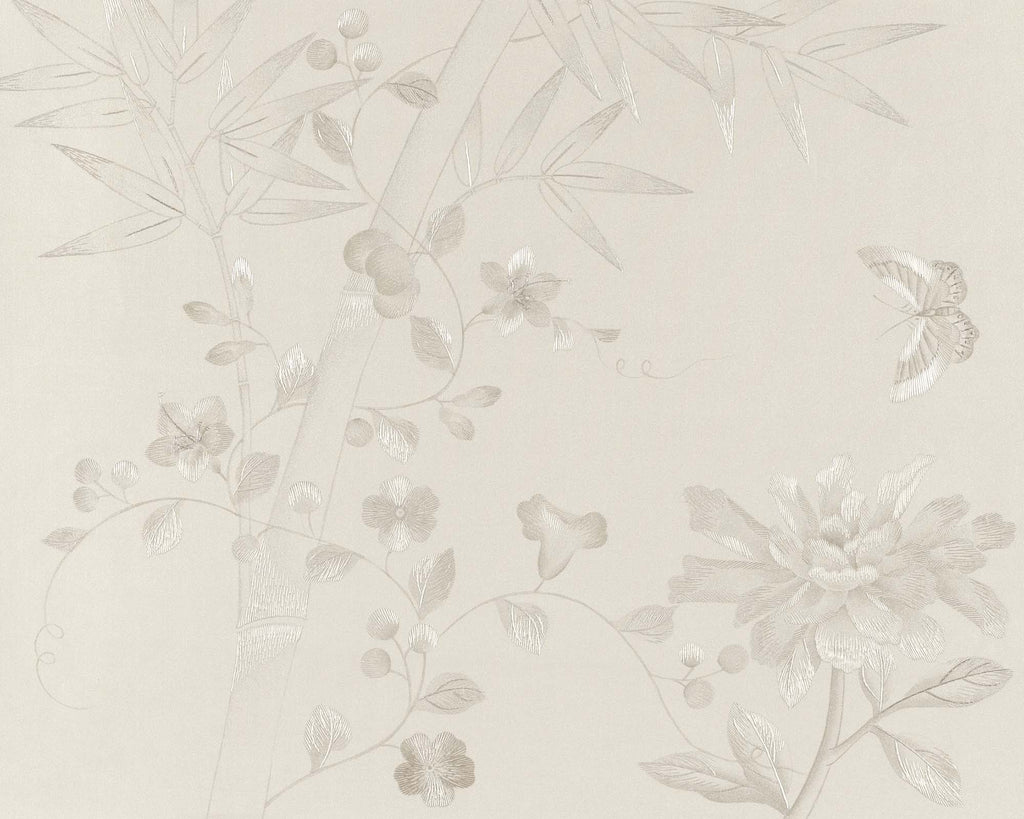
Unspun silk floss is almost nothing to hold — finer than a human hair, split sometimes into sixty-fourths of a single strand. Yet, in the hands of a Suzhou embroiderer, these near-invisible threads, hand-dyed across thousands of shades, become something magnificent. Blossoms take form. A crane lifts its wing. A whole garden comes to life. Stitch, by painstaking stitch.

This is Suzhou embroidery — one of the world's finest art forms, and one of its oldest continuously practised crafts. Truly a women’s art, the knowledge that sustains it has always lived in female hands, passed from mother to daughter, grandmother to granddaughter, across more than two millennia.It is also a cornerstone of Fromental's creativity. This International Women’sMonth it feels apt to tell that story, and to celebrate the women, historic and contemporary, who have made it their life's work.

A stone bridge crossing one of Suzhou’s canals.

A City, A Craft, A Lineage

The story begins in Suzhou, a city on China's lower Yangtze River, known for centuries as a centre for silk production. More than two thousand years ago, women first began adorning their garments with intricate needlework here, though the foundational myth reaches back even further still. According to legend, Empress Xi Ling-shi first discovered silk when, sitting beneath a mulberry tree, a silkworm cocoon fell into her tea and slowly unravelled. She is credited with both the invention of the loom and the practice of sericulture. 

Over the centuries that followed, embroidery became woven into the fabric of Suzhou life. Daughters learnt from their mothers, techniques were refined, and what began as ornamental needlework evolved into something far more ambitious. 

An embroidered work from the Qing Dynasty (1644–1911). The precise, yet ornate depictions of birds and flora typical of the period's style.

By the Song Dynasty (960–1279), Suzhou embroiderers began translating the greatest artworks of their time — literati depictions of landscapes, botanicals and birds — into silk, matching them in nuance and fidelity. Working with threads as fine as human hair, these artisans produced work of such painterly depth that the practice earned a new name: painting by needle

By the Qing Dynasty (1644–1911), the craft had reached the imperial court, adorning royal robes and palace walls. It was here that embroiderers first achieved the technical innovation of double-sided embroidery, in which identical or entirely different designs appear on both sides of a single, translucent silk panel. With no equivalent existing in Western textile tradition, it remains one of the most impressive feats in the history of the needle arts.

Architects of Craft

Two pioneering women deserve recognition, not only for the preservation of Suzhou embroidery, but its transformation.

Shen Shou (1874–1921)

Shen Shou stands apart as the most revolutionary figure in the craft's modern history. Fusing Eastern embroidery with influences drawn from Japanese technique, Western oil painting, and portraiture, she invented an entirely new aesthetic vocabulary for the medium.

Fully embroidered portrait of American actress Billie Burke. Shen Shou, 1918.

The results were unlike anything seen before. Portrait of an Italian Empress (1911) was presented as a Qing Dynasty state gift to Italy and awarded first prize at the Turin International Exposition, affirming embroidery’s place on the world stage. Soon after, her embroidered likeness of American actress Billie Burke demonstrated the extraordinary verisimilitude of her “lifelike” style — silk thread rendered with the tonal subtlety of oil paint. 

Appointed Director of the Nantong Needlework Learning School, which was the first institution to formally systematise and teach the craft, Shen Shou also authored the Xuehuan Embroidery Guide. This iconic manual is the earliest written account codifying Suzhou embroidery technique, transforming an inherited domestic art into a modern discipline. 

Yang Shouyu (1896–1981)

Yang Shouyu radically expanded the technical language of the medium. In the early 1930s, she pioneered random-stitch embroidery, a decisive break from the classical style.This was an improvisational, layered method, crossing threads to build tone and depth.

The shift was as transformative for embroidery as Impressionism was for painting. It signalled an intentional move away from rigid precision, towards atmosphere and emotional resonance. Yang asked not only what the medium could depict, but what it could express.

A Thread that Held

During the Cultural Revolution (1966–1976), China’s fine arts and crafts were systematically driven to the brink of extinction. Labelled bourgeois or counter-revolutionary, workshops were shuttered, artists persecuted, and lineages of skill severed. 

That Suzhou embroidery endured at all is owed, in no small part, to the women who quietly sustained it within the domestic sphere. Practised behind closed doors, the craft was passed from one generation to the next, its techniques preserved and shared in private until China’s reopening in the 1980s. 

In 2006, Suzhou embroidery was formally inscribed on China’s national list of intangible cultural heritage, a long-overdue recognition of what women had upheld for generations.

A Living Tradition

The Suzhou artisans who hand-embroider Fromental’s silk panels today stand in direct lineage to these pioneering craftswomen. Heirs to centuries of stylistic refinement and technical innovation, they carry forward a living tradition shaped as much by resilience as by artistry. Using the same ultra-fine, unspun silk floss and the same meticulous hand-dyeing methods as their great-grandmothers, they work with uncompromising precision: a single blossom may require six hundred individual stitches; a single panel can demand up to four hundred hours to complete. 

Many learned the discipline at their mothers’ side, and many still work collaboratively from one another’s homes, sustaining a practice that has always moved between the domestic and the masterful. 

International Women’s Day offers a moment to name what is too often left unnamed — the labour, knowledge, and skill women have carried through history, frequently without the recognition they deserve. Suzhou embroidery is, in its entirety, such a story: an art form created, refined, revolutionised, and preserved by women across two and a half thousand years. 

When an embroidered Fromental wallcovering reaches its final home — when it dresses the walls of a drawing room or a hotel suite, when guests pause before a hand-embroidered panel — what they are looking at is not mere decoration. It is the visible surface of a lineage, the presence of the women who mastered the craft felt in every stitch.